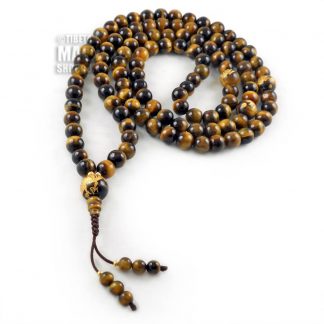

A Five Step Beginner’s Guide to Mala Beads Meditation
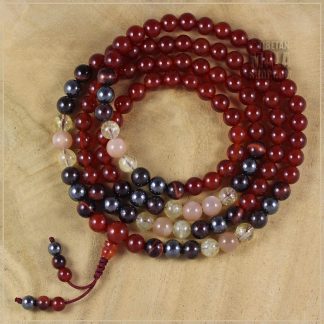
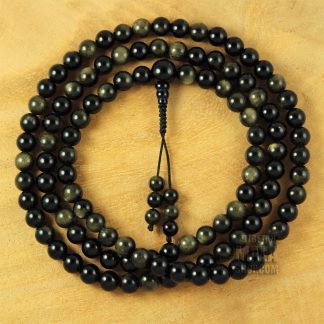
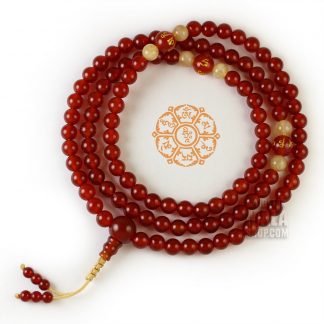
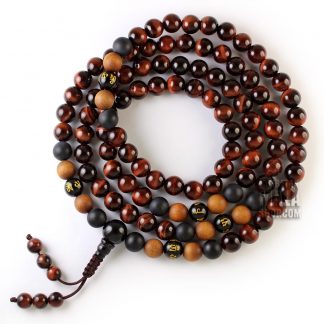
Mala beads (or Japa Malas) have been used for thousands of years as a tool for meditation and mindfulness. While they can look like beaded jewelry, they are designed to help you count breaths or mantras so you can focus on your internal state rather than keeping track of numbers. Here is a guide on how to use them effectively.

Step 1. How to Hold Your Mala
In many traditions (especially Hindu and some Buddhist lineages), there are specific guidelines for handling the beads to maintain their sacred energy.
- The Hand: traditionally, the right hand is used to hold the mala. In some cultures, the left hand is considered “unclean,” though in Tibetan Buddhism, either hand is often acceptable.
- The Fingers: drape the mala over your middle or ring finger.
- The Thumb: use your thumb to “hook” a bead and pull it toward you as you complete a mantra or breath.
- The Index Finger: most traditions suggest keeping your index (pointer) finger away from the beads. It is often seen as representing the “ego” or the “accusing finger,” so it’s best to keep it pointed away or tucked in.
Step 2. The Meditation Process
The goal is to move through all 108 beads (the traditional number) to complete one full cycle of meditation.
- Start at the Guru Bead: this is the larger bead at the center, often marked by a tassel. Do not count this bead; it is your starting and ending point.
- The First Bead: start with the bead immediately to the right (or left) of the Guru bead.
- One Bead, One Mantra: for every bead you touch, recite your chosen mantra once (silently or aloud).
- One Bead, One Breath: if you aren’t using a mantra, simply take one full inhale and exhale for every bead you move.
Common Mantras: “Om,” “I am at peace,” or “Om Mani Padme Hum.” - The Pulling Motion: gently pull the bead toward your body as you finish the mantra, symbolising that you are drawing the energy or intention into yourself.
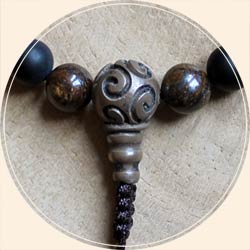
Step 3. The “Guru Bead” Guidance
When you have gone all the way around the 108 beads and reach the Guru bead again, do not cross over it. Crossing over the Guru bead is traditionally seen as “stepping over your teacher.”
- To Stop: take a moment to sit in silence, offering gratitude or a final intention.
- To Continue: if you want to do another round, simply flip the mala around and go back in the opposite direction from which you came.
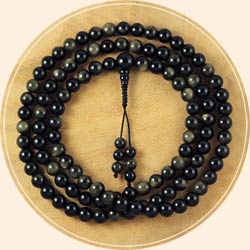
Step 4. Why 108 Beads?
You might wonder why that specific number. In Vedic culture, 108 is considered a sacred number representing the wholeness of existence:
- Energy Channels: it is said there are 108 nadis (energy lines) that converge to form the heart chakra.
- Cosmic Scale: the diameter of the Sun is roughly 108 times the diameter of the Earth.
- Alphabet: the Sanskrit alphabet has 54 letters, each with a masculine and feminine form (54 x 2 = 108).
The Counter Beads: there are often an extra 3 counter beads, also known as spacer beads or marker beads. They are especially common in Tibetan Buddhist malas, and they serve both a practical and a symbolic purpose. While a standard mala has 108 beads, a mala with these 3 spacers will often have a total of 111 beads (plus the Guru bead).
The most common reason for those three beads is to divide the 108 beads into four equal sections of 27. In a long meditation session, it’s easy for the mind to wander. The spacer bead gently nudges you back to the present moment and lets you know you are quarter, half the way through your practice without you having to open your eyes.
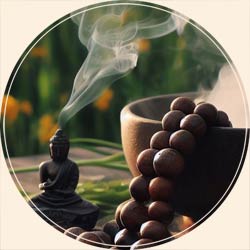
Step 5. Care and Cleansing
Because malas are “kinesthetic tools,” they absorb the energy of your practice and the oils from your skin.
- Cleansing: you can “reset” the energy of your beads by placing them in the light of a full moon or by “smudging” them with sage or palo santo smoke.
- Physical Care: if your beads are wood (like sandalwood) or seeds (like Rudraksha), avoid getting them wet, as they can crack. If they get dirty, a very soft, damp cloth is best.
- Storage: when not in use, keep them in a dedicated pouch or on a home altar rather than leaving them on the floor.